Pages

Showing posts with label India Indicator 2010. Show all posts

Sunday, April 18, 2010

CHART OF THE WEEK: LIKE CHINA, INDIA NEEDS A LOT MORE OIL

Last week, we featured a chart produced by our colleague Bud Conrad of The Casey Report. It showed the enormous oil consumption growth of the world's most populous nation, China.

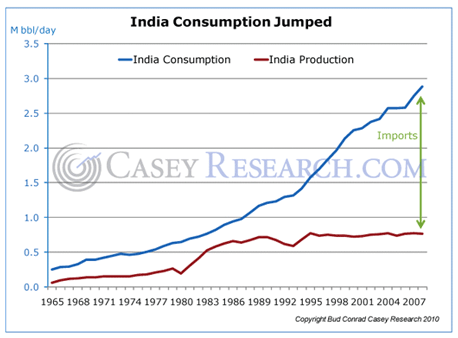
Today, we show you another amazing oil-consumption chart. This time, it's the mushrooming demand coming from the world's second most-populous nation, India.

India's car sales surged 25% last year from the previous year, according to an industry group. The group also reports that India's car sales have climbed at an annual clip of 10%-14% for the past decade. That's driving the amazing uptrend (blue line) you see below. It's also causing India to import more and more oil each year.

Thursday, March 4, 2010

Forget China, invest in this incredible emerging market

Emerging-markets guru Mark Mobius thinks India will do better than the other countries known as "BRICs," Brazil, Russia, and China. Mobius manages $34 billion of emerging-markets assets for Templeton Asset Management. His largest commitments are in Brazil, India, and China.

In comments posted on Templeton's website, Mobius points out, "Most Indian companies have healthy balance sheets and strong cash flows. The Indian stock market was a good performer in 2009 and we expect it to continue to outpace other emerging markets next year."

The view on the ground in India tells me Mobius could be right. The culture here is as entrepreneurial as any on Earth, and much more than most. The country has a history of trading and commerce that goes back thousands of years. It has a tradition of land ownership – with zero debt – that goes back millennia, too. Can you imagine what the last few years would have been like if the United States had a culture based on the notion of owning land with 100% equity?

I realize unleveraged land ownership isn't a magic bullet, but when I asked around about India's banks, the answer was simple: "They're just fine." Of course they're fine. They don't lend money to people to buy land.

There's as much hustle and bustle here as any place in the world. Today, I left Chennai and flew 40 minutes to Coimbatore, then drove two hours over newly paved roads to Erode to visit a pulp and paper plant. The streets of Chennai were mobbed. The streets of Coimbatore – a "small town" of 2 million – were mobbed. The streets of Erode were mobbed. The streets of the gold district were mobbed on Sunday morning when we went there. There ain't no recession here.

The flight to Coimbatore cost $40. The flight back to Chennai cost $70 and featured a full, fresh, hot South Indian meal with soup, a main course, and dessert, which was delicious. Everywhere you go in this country, the service is prompt and friendly, and the airlines we flew today – SpiceJet and Paramount – were no different. The cell phone reception is better than anywhere in the States, and you can make international calls for a few cents a minute (Sprint, on the other hand, wants $2.49 a minute).

Another thing I've noticed here in India... the rules for certain notoriously unprofitable businesses seem to be different. Both the airlines we flew today are profitable. There are six business newspapers in this country. All of them are profitable. Businesses like sugar refining and paper making are generating 25%-30% or higher returns on capital. That tends only to happen in a rapidly growing economy. India's GDP has been growing 7%-9% a year the last four years. I think it can probably do that for several years to come.

Jim Rogers knocks India, saying it's too bureaucratic... But I've asked my hosts how long it would take to set up a vehicle to purchase land for, say, a hotel or apartment development. The answer shocked me: 30 days. So the fact that foreigners can't open an Indian brokerage account doesn't mean they can't put money to work here.
Sunday, February 28, 2010

India is in the race to own the world

A few weeks ago we noted the world's largest coal producer, Coal India, was on the hunt for global assets to expand their reach. It appears this is now part of a broader national strategy mimicking what China has been doing the past half decade+.

If you have any Malthusian bones in your body, you have to wonder as certain countries waste all their national treasure on bailing out banks, financing the lifestyles of those who refuse to save for themselves, and funding pet projects of their politicians - while others are attempting to snatch up as many long lived assets across the globe, what the long term implications will be.

Saturday, January 23, 2010

The No. 1 reason to invest in emerging markets

The streets of Mumbai, India, are so congested, you can't walk on them. So the city is going to spend $300 million to build 50 elevated steel walkways to allow pedestrians to get where they're going. Mumbai has nearly 18 million people and its sidewalks are crowded with street vendors, some of whom have been selling their wares on the same spot for 20 years or more, according to the Wall Street Journal.

I hear the word "infrastructure" thrown around a lot, especially when investors talk about China and India. But I rarely hear anyone tell me what it really means in simple terms that anyone can understand.

A city of 18 million without enough sidewalk space... that I understand.

Mumbai's space problem reminds me of Julian Simon, economist and author of The Ultimate Resource II. The ultimate resource Simon refers to is human beings. Peak Oil proponents and other environmental alarmists don't get that with every new mouth to feed comes a new brain that thinks. Though there can certainly be short-term shortages of various goods and services - like walking space - over the long term, the rule for humanity has been abundance.

Think about New York City. Today's population (19 million) is roughly similar to Mumbai's. But 150 years ago, the population of pre-Civil War New York wasn't near its current size, and the city would be hardly recognizable compared with today's metro area.

Given Mumbai is starting off with enormous population resources, imagine what 150 years of progress will look like there. New York to the 10th power? It boggles the mind.

This potential for huge growth excites investors more than just about anything else. It's the reason Jim Rogers remains so bullish on China, despite his admission that property markets there are overheated. I'm heading over to Chennai, India, in early March. Maybe I'll have a good sidewalk story to tell when I get back.

Wednesday, January 6, 2010

The new Scramble for Africa: India vs. China

The nearly insatiable hunger for oil has led the world’s most-populous countries to Africa. And while China’s efforts to tap Africa’s oil resources are well known, India is trying to catch up.

Earlier this month, during an India-Africa summit in New Delhi, which was attended by representatives from 15 African countries, it became clear that India needs to learn from China’s success in dealing with Africa. The resource base is certainly attractive. Africa has about 10% of the world’s oil reserves and the oil tends to be of better quality than the high-sulfur crude found in India.

THE MONEY MARKET

FRIENDS